

 2. What Is an Ayahuasca Retreat?
An Ayahuasca retreat is often misunderstood. Many people imagine it as a single ceremony — an intense evening, a unique experience, perhaps even a personal “breakthrough.”
In reality, however, a retreat is a much more comprehensive process. It is a consciously created space in which different elements come together, complement one another, and only unfold their full depth when experienced as a whole.
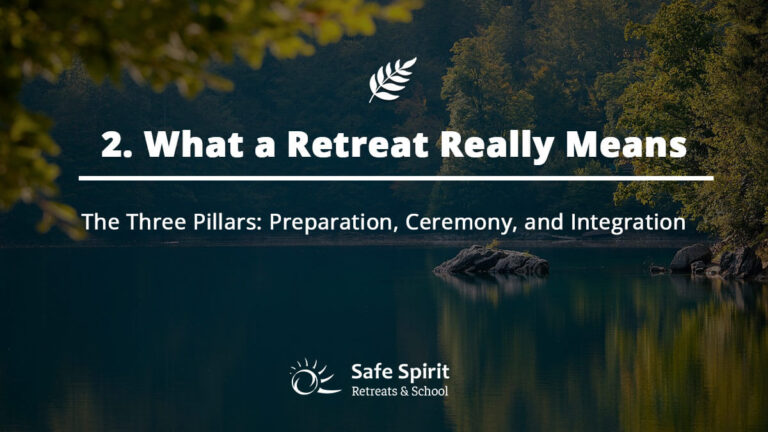
At its core, a retreat consists of three central pillars:
- preparation on a mental, emotional, and physical level
- the ceremony itself — or multiple ceremonies
- integration, meaning the processing and understanding of the experience
These three areas should not be seen as separate from one another, but rather as parts of one connected process.
The ceremony itself is not the final goal, but one part of a larger journey. Without preparation, inner stability is often missing, and without integration, even a profound experience may remain unclear or gradually lose its meaning.
 More Than Just the Ceremony
Although the ceremony receives most of the attention, it is only one part of the overall experience. A retreat creates a framework in which you can truly turn toward yourself — without distraction, external pressure, and within a clear and supportive structure.
A well-held retreat environment can offer:
- time to settle into the process and open internally
- a protected space for emotional and mental processes
- support from experienced facilitators
- opportunities for reflection and integration
In addition, the group itself often creates a unique dynamic. Even though everyone goes through their own personal process, the shared space can help people feel less isolated and more connected to the experience.
 The Role of the Facilitator
One of the most important factors influencing the quality of a retreat is the facilitation itself. The facilitator or support team is not there to control your experience or direct it toward a certain outcome.
Rather, their role is to hold a safe, stable, and conscious space in which your own process can unfold naturally.
Important responsibilities of the facilitators include:
- creating a safe and trustworthy setting
- supporting participants during intense emotional processes
- providing clear communication and structure
- offering guidance for integration afterward
What matters here is not only knowledge or techniques, but above all experience, presence, and a strong sense of responsibility. A good facilitator recognizes when support is needed — and when it is more important simply to allow space.
 Retreat vs. Single Ceremony
A common misunderstanding is to equate a retreat with a single ceremony. The difference, however, is significant and directly affects the overall quality of the experience.
A single ceremony often offers:
- an intense but isolated experience
- little or no preparation
- minimal space for integration
- limited individual support
A retreat, on the other hand, creates a more complete process:
- conscious arrival and preparation
- multiple ceremonies that may build upon one another
- time for reflection and meaningful exchange
- integration during and after the retreat
This difference becomes essential when the intention is not simply to have an experience, but to support lasting inner transformation.
 The Safe Spirit Perspective: Process Instead of Experience
From the perspective of Safe Spirit, an Ayahuasca retreat is not an “event” to consume, but a conscious process that is intentionally created and responsibly guided.
The focus is not on accumulating intense experiences, but on being able to understand, process, and integrate what arises.
This also means:
- less focus on spectacular experiences
- more focus on stability and clarity
- honest guidance instead of promises
- integration as a central part of the process, not an optional extra
A retreat offers the opportunity to encounter yourself more deeply. But this encounter requires a framework that supports you — before, during, and after the ceremony.
 The Defining Difference
Ultimately, the greatest difference lies not in the substance itself, but in the context in which it is experienced.
A consciously created environment can make the difference between an intense experience and a meaningful inner process.
What truly matters:
- the experience and attitude of the facilitators
- integration as an essential part of the process
- your own willingness to engage honestly
An Ayahuasca retreat is therefore not simply an experience you “have.” It is a process you consciously enter — one that extends far beyond the ceremony itself.
 3. Ayahuasca in Europe: Opportunities and Risks
Ayahuasca retreats in Europe offer more opportunities today than ever before — and within this growth lies both potential and risk.
As interest has expanded, a diverse market has emerged: from deeply responsible and meaningful work to more superficial offerings focused primarily on the experience itself rather than genuine inner processes.
For you, this means that the quality of your experience depends greatly on how consciously you choose and how clear you are within your own decision-making process.
The opportunities mainly lie in the fact that retreats in Europe often take place closer to your real life — geographically, culturally, and psychologically.
You remain within an environment that feels more familiar, which can make it easier to engage with the process and later integrate the experience into everyday life. Many facilitators in Europe also place a stronger focus on structure, smaller groups, and closer personal support.
Common advantages include:
- shorter travel and less external stress before the process
- a more familiar cultural environment and language
- more personal support through smaller groups
- a stronger focus on preparation and integration
At the same time, the growing market also creates risks that should not be underestimated. There are no universal standards, no clear regulation, and often major differences in the experience and responsibility of retreat providers.
Not every retreat automatically provides a safe or meaningful environment.
Possible risks may include:
- inexperienced or untrained facilitators
- large groups with limited individual support
- a focus on “experience” rather than long-term integration
- little or superficial preparation
- unclear communication about responsibility and potential challenges
A common mistake is allowing external factors to guide the decision — such as beautiful locations, impressive visuals, or strong promises.
Yet these elements say very little about how a retreat is actually facilitated. What matters is not how something appears, but how consciously and responsibly the process is held.
When choosing a retreat, it is worth looking deeper rather than deciding based only on price or location.
Important questions may include:
Is there clear preparation? Is integration actively supported? How much real experience does the team have? How large is the group? Are challenges discussed openly, or only the positive aspects?
Typical warning signs (red flags) include:
- unrealistic promises such as “guaranteed healing” or “life-changing overnight”
- lack of transparency regarding preparation, structure, or integration
- very large groups with little personal support
- a stronger focus on marketing than on substance
- little space for questions or personal clarification beforehand
From the perspective of Safe Spirit, the goal is not to find a retreat as quickly as possible, but to find the right environment for you.
Ayahuasca is not a product to consume, nor an event to simply “experience.” It is a process that requires responsibility — from the facilitators as well as from yourself.
The most important question is therefore not only whether a retreat is available, but whether it truly fits you, your situation, and where you currently are in life.
4. Preparation: How to Prepare Yourself Consciously
The quality of your Ayahuasca experience does not begin in the ceremony itself, but long before it.
The moment you consciously decide to walk this path, the process has already begun. Many people underestimate preparation or view it as secondary, even though it is one of the most important factors of all.
Preparation strongly influences whether you enter the experience with stability, openness, and clarity — or with expectation, pressure, and inner tension.
The most important aspect of preparation is not physical, but mental and emotional. It is not about creating the “perfect” intention or knowing exactly what should happen.
What matters far more is honesty with yourself. Instead of asking what you want to achieve, it can be more helpful to explore what is truly present within you right now.
Helpful questions for self-reflection include:
- What is truly moving me in my life at the moment?
- Where do I feel uncertain, blocked, or unclear?
- Which themes might I be consciously or unconsciously avoiding?
- Am I willing to face uncomfortable aspects of myself?
An intention is not a form of control over the experience, but rather an inner orientation. The more honest you are with yourself, the more naturally the process may unfold — often in ways that cannot be planned beforehand.
Individual Preparation Instead of Strict Rules
Alongside mental preparation, physical preparation also plays a role. The so-called “Ayahuasca diet” is often interpreted in very different ways, but at its core it is less about rigid rules and more about awareness.
At the same time, one important aspect is often overlooked: preparation is always individual.
Not everyone is at the same point in life. Modern lifestyles, stress, nutrition, technology, mental overload, and existing physical or psychological conditions all influence what meaningful preparation may look like for a person.
While some people can easily follow a very strict or simplified diet, for others this may not be realistic — or may even become counterproductive.
Important aspects of individual preparation include:
- your current physical condition
- your stress levels and daily environment
- your nutrition and personal habits
- possible sensitivities or existing conditions
- your emotional stability and life situation
This means there is no single “correct” preparation that applies equally to everyone.
Still, common recommendations may provide useful orientation:
- avoiding alcohol and other substances for several days beforehand
- eating light, natural, and minimally processed foods
- reducing sugar and heavy meals
- minimizing excessive stimulation for the body and mind
What matters most is not how perfectly you follow these recommendations, but how consciously you relate to them.
Excessive discipline or pressure to “do everything right” can become just as unhelpful as no preparation at all.
 Preparing Within a Modern Lifestyle
Especially in the modern world, preparation is often less about strict traditional rules and more about conscious adjustment.
Today’s lifestyles differ greatly from traditional ceremonial contexts — with constant stimulation, digital overload, mental stress, and little space for silence or reflection.
Meaningful preparation today may therefore also include:
- consciously reducing screen time and digital input
- creating more space for rest and solitude
- setting clearer boundaries around stress and external influences
- bringing more stability into daily life before the retreat
Expectations, Control, and Inner Pressure
Many difficulties do not arise from Ayahuasca itself, but from the inner attitude with which people enter the experience.
Expectations, control, or pressure can block the process more than support it. When you attempt to force a specific outcome or direct the experience in a certain way, you often work against what naturally wants to emerge.
Common inner obstacles include:
- fixed expectations (“I need healing,” “I want answers”)
- trying to control the experience
- internal pressure to achieve something specific
- comparing yourself to other people’s experiences or stories
A more supportive mindset is often:
- openness toward whatever may arise
- willingness to let go of control
- trust in the process, even when it feels unclear
- patience and compassion toward yourself
Perhaps the most important aspect of preparation is your inner orientation — not the belief that your life will automatically change, but the willingness to meet yourself honestly, regardless of what arises.
This attitude creates the foundation for an experience that is not only intense, but also capable of unfolding meaningful long-term impact.
 8. The Cost of an Ayahuasca Retreat in Europe
The prices of Ayahuasca retreats in Europe can vary significantly — and this often creates uncertainty for many people.
At first glance, it may seem as though price directly reflects quality. In reality, however, the cost alone is not a reliable indicator of how meaningful, safe, or well-held a retreat truly is.
Some retreats appear very affordable, while others are highly priced, but neither automatically guarantees depth, responsibility, or quality.
At its core, you are not simply paying for accommodation or food. You are investing in an entire process — including preparation, support during the ceremonies, the quality of the environment, and especially the integration afterward.
These are often the least visible aspects, yet they are usually what make the greatest difference.
In Europe, many retreats fall within a general price range that can serve as orientation.
Shorter retreats lasting one to three days often range between €300 and €900, while longer programs with deeper support or extended integration may range from €900 to €2000 or more.
These differences are influenced by factors such as duration, group size, the experience of the facilitators, and the level of support provided.
Typical elements included in a retreat are:
- accommodation and meals during the stay
- one or multiple ceremonies
- preparation and introduction to the process
- support from the team during the experience
- integration during the retreat itself
Some retreats may also offer additional elements such as:
- post-retreat support or online integration sessions
- individual conversations or coaching
- additional practices such as breathwork or meditation
Yet this is where an important point becomes clear:
more offerings do not automatically mean more quality.
A retreat may include many extras and still remain superficial, while a simpler setting with clear structure and experienced facilitation can often create far more depth.
One common mistake is to look at the price in isolation and base the entire decision on it.
Very inexpensive retreats may appear attractive, but important aspects are sometimes reduced — such as group size, individual support, or meaningful integration.
At the same time, a high price may reflect marketing, location, or luxury elements without necessarily offering deeper or more responsible work.
More important questions to consider are:
- How much real experience and presence does the team bring?
- How individual and attentive is the support during the retreat?
- Is there genuine preparation and integration — or only the ceremonies themselves?
- Is it communicated transparently what is actually included in the price?
These questions usually provide far more orientation than the number itself.
From the perspective of Safe Spirit, it can be helpful to view the price not simply as a cost, but as an investment into an inner process.
At the same time, it is important to remain realistic:
money alone does not create transformation.
You may pay a large amount and take very little with you — or pay comparatively little and still have a deeply meaningful experience when the environment is supportive and you are genuinely willing to engage.
What ultimately makes the difference is not the price itself, but the combination of inner and outer factors, including:
- your own willingness to honestly engage with the process
- the quality of the environment and facilitation
- your openness during the experience
- and especially your integration afterward
An Ayahuasca retreat is not a service like a hotel stay where you pay mainly for comfort or entertainment.
It is an intense inner process that may touch multiple layers of your experience.
For this reason, your decision should not depend primarily on the cost itself, but on whether the environment genuinely supports you.
In the end, the goal is not to find the cheapest or most expensive retreat — but the right one.
A retreat is not simply a consumer choice, but a conscious decision. And the more clarity you bring into that decision, the more meaningful the process may ultimately become for you.
 9. Is an Ayahuasca Retreat Right for You?
This is one of the most important questions within the entire process — and at the same time, it is a question that nobody outside of you can truly answer.
An Ayahuasca retreat is not simply the “next logical step,” a trend to follow, or an experience to casually try out.
It is a conscious decision that is deeply connected to your current life situation, your inner stability, and your willingness to encounter yourself honestly.
Many people become interested in Ayahuasca because they feel that something in their life wants to change. Perhaps there are recurring patterns, emotional struggles, or a feeling of disconnection or confusion.
But this is exactly where an honest distinction becomes important:
am I simply looking for an experience — or am I genuinely ready for change?
A retreat can become a meaningful and powerful impulse when a certain inner foundation is already present.
Being “ready” does not mean being perfect. It means bringing a certain level of stability, openness, and honesty into the process.
An Ayahuasca retreat may be meaningful if you:
- feel disconnected from yourself or emotionally stuck
- are willing to honestly engage with your inner patterns and themes
- are open to emotional processes, even when they feel uncomfortable
- are not searching for quick solutions, but for deeper understanding
At the same time, there are situations in which a retreat may not be the right step at this moment.
This does not necessarily mean that Ayahuasca is “not for you,” but simply that the timing may not currently be supportive.
A retreat may not be appropriate right now if you:
- are currently in an acute emotional or psychological crisis
- experience strong instability or overwhelm in daily life
- expect Ayahuasca to solve your problems for you
- are unwilling to take responsibility for yourself and your process
Ayahuasca can intensify inner processes — and this is exactly why it is important to assess yourself realistically. The goal is not to limit yourself, but to avoid overwhelming yourself.
Within the Safe Spirit perspective, this decision is always rooted in personal responsibility. No one else can truly feel whether this step is aligned for you right now. An honest self-assessment is often more valuable than any external recommendation.
Helpful questions to reflect on may include:
- Why do I truly want to participate?
- Am I driven by curiosity or by genuine inner work?
- Am I willing to face uncomfortable aspects of myself?
- Do I have space in my life to integrate the experience afterward?
These questions are not meant to create fear or doubt, but clarity. And clarity is one of the most important foundations for a meaningful experience.
 The Importance of Timing
Another important aspect is timing.
Even if Ayahuasca strongly resonates with you, this does not automatically mean that now is the right moment.
Sometimes it may be more supportive to first create greater stability within your life before entering an intense inner process.
In other cases, this exact step may become the beginning of meaningful change.
The difference often lies in your inner attitude and the way you approach the experience.
Escape or Conscious Decision?
Within the modern world, another challenge often appears:
many people search for intense experiences because they feel disconnected from themselves or from daily life.
But a retreat should not become a place of escape.
If the deeper motivation is to avoid your life rather than consciously engage with it, the experience may become more confusing than clarifying.
A healthy foundation for this decision often includes:
- honesty instead of idealization
- willingness instead of expectation
- stability instead of escape
- responsibility instead of dependency
From the perspective of Safe Spirit, there is no absolute “right” or “wrong.”
An Ayahuasca retreat is one possible path — not the only one.
For some people it may become an important step, while for others it may simply not be the right time yet.
The most important question is therefore not whether you “should” participate, but whether you genuinely feel ready to encounter yourself more deeply.
Not from pressure.
Not from curiosity alone.
But from a place of inner clarity.
Because ultimately, the goal is not simply to have a special experience.
It is to live your life more consciously.
10. Common Mistakes & False Expectations
Many of the difficulties people experience in connection with Ayahuasca do not arise from the experience itself, but from the expectations they bring into the retreat.
In a modern society strongly shaped by self-optimization, quick solutions, and the pursuit of intense experiences, Ayahuasca is often unconsciously placed into the same framework.
It is frequently seen as a “tool” that should fix, solve, or transform something — ideally quickly and permanently.
This is where one of the most fundamental misunderstandings begins.
From the perspective of Safe Spirit, it is therefore essential not to simply carry these expectations into the experience without reflection.
Ayahuasca does not function according to a predictable cause-and-effect system like many areas of modern life.
There is no guarantee of specific results, no fixed development, and no predetermined way in which something must unfold.
Instead, it creates a space in which you encounter yourself — and this can look very different for every individual.
The Expectation of Instant Transformation
One of the most common and problematic expectations is the belief that Ayahuasca will fundamentally change your life.
Many people enter a retreat hoping to become a “new person” afterward or finally receive clear answers to their most important questions.
While this hope is understandable, it often shifts responsibility outward.
Ayahuasca may offer insights, confront you with yourself, and open new perspectives — but it does not change your life on its own.
Real transformation always depends on your own choices, behavior, and integration afterward.
Closely connected to this is the expectation that a single ceremony will fully resolve complex emotional or personal themes.
In reality, inner processes rarely unfold in a linear way.
Some layers become visible immediately, others remain hidden, and some only emerge much later.
An experience may become an important impulse — but rarely a final solution.
Those who enter with the belief that “everything will be solved afterward” often leave disappointed or confused.
Common unrealistic expectations therefore include:
- the idea of fast and complete healing
- expecting clear answers to all life questions
- believing that one ceremony is enough
- assuming the experience will mainly feel positive or pleasant
 Romanticizing the Experience
The last point is especially underestimated.
Ayahuasca is often romanticized as something purely light-filled, healing, or magical.
Yet an essential part of the process often involves encountering aspects of yourself that previously had little space or awareness.
This may include uncomfortable emotions, old memories, inner conflict, or difficult truths.
These processes can feel intense and challenging — and this is often where their deeper value lies.
Not because everything feels good, but because something honest becomes visible.
The Illusion of Control
Another central issue is control.
Many people unconsciously enter the experience trying to direct it.
They want to see certain visions, receive certain insights, or avoid difficult emotions.
Yet this attempt to control the process often becomes one of the biggest obstacles.
Ayahuasca is not a tool you control — it is a space in which something reveals itself.
When you attempt to manipulate or force this process, inner resistance often arises.
Common inner dynamics include:
- holding onto expectations (“Something should happen now”)
- trying to avoid uncomfortable experiences
- internal pressure to achieve something meaningful
- comparing yourself to the stories or experiences of others
These dynamics often prevent people from truly experiencing what is actually present, because they remain focused on evaluating, controlling, or directing the experience toward a certain outcome.
As a result, much of the deeper potential may be lost.
Spiritual Bypass
One particularly subtle yet very common mistake is what is often called “spiritual bypass.”
This happens when difficult emotions or unresolved issues are not genuinely felt, but instead covered over with spiritual concepts or positive interpretations.
Instead of truly engaging with pain, fear, insecurity, or conflict, everything is quickly reframed into a spiritual narrative.
While this may create temporary relief, it often prevents deeper long-term growth.
Typical examples include:
- explaining everything as “part of the plan” without truly feeling it
- immediately reframing difficult emotions instead of allowing them
- collecting insights without applying them in daily life
- using intellectual understanding to distance yourself from direct experience
Within the Safe Spirit approach, the goal is not to collect as many insights as possible or to chase especially intense experiences. The intention is to remain honest with whatever genuinely appears — even when it feels unclear, contradictory, or uncomfortable.
Real development does not come from avoiding difficulty, but from consciously meeting it.
A supportive inner attitude may therefore include:
- openness toward the unknown instead of fixed expectations
- willingness to let go of control
- patience with your own process
- taking responsibility for your personal development
This attitude creates space for an experience that unfolds organically rather than being forced.
It allows you to encounter what is truly there — not simply what you expected to find.
 Comparison and Social Media Expectations
Another important challenge in the modern world is the tendency to compare and evaluate experiences.
Through social media, online stories, and personal reports, many people develop an idea of what a “deep” or “successful” Ayahuasca experience should look like.
This can easily lead to perceiving your own experience as “not enough” or somehow “wrong.”
It is important to understand that:
- every experience is individual
- intensity is not the same as depth
- even quiet or subtle processes can be deeply meaningful
- the true value often reveals itself later through integration
Ultimately, the greatest mistake is not “doing something wrong,” but believing that Ayahuasca will do the inner work for you.
It may show you something, move you emotionally, or open new perspectives.
But it does not walk the path for you.
And this is the essential difference:
The experience itself does not change your life — your relationship to it does.
 11. The Effects of Ayahuasca: Inner Worlds, Perception & Shamanic Context
The effects of Ayahuasca are often described as something mystical or difficult to fully explain.
And in many ways, this is true — because the experience can unfold simultaneously on multiple levels: physical, emotional, mental, and perceptual.
At the same time, it can be helpful to develop a grounded understanding of these effects in order to better navigate and integrate the experience afterward.
At its core, Ayahuasca changes the way you perceive yourself and your inner world.
Thoughts, emotions, and memories often become more visible and emotionally vivid. Hidden connections may emerge, and aspects of yourself that normally remain in the background can suddenly move into focus.
Some people experience deep emotional processes, others receive insights or clarity, while some perceive symbolic imagery, visions, or entire inner “scenes.”
Common areas of experience may include:
- heightened awareness of emotions and inner states
- access to memories or unconscious themes
- new perspectives on life and personal patterns
- visual impressions or symbolic imagery
- a changed perception of time, space, and identity
These experiences can feel extremely real — sometimes even more intense than ordinary reality itself. This is why many people describe them as entering “other worlds.”
“Other Worlds” — What Does That Really Mean?
Many people report feeling as though they enter other worlds during an Ayahuasca experience or come into contact with something larger than their ordinary sense of self.
Within shamanic traditions, this is often described in terms of spiritual realms, energies, or altered states of consciousness.
From the Safe Spirit perspective, it is important to approach these experiences with openness while remaining grounded at the same time.
Possible ways to understand these experiences include:
- expressions of your inner psychological landscape
- symbolic processing of emotions and life experiences
- an altered state of consciousness allowing new perspectives to emerge
What matters less is what these experiences “objectively are,” and more how you relate to them and what meaning they hold for you personally.
A supportive attitude may include:
- openness toward the experience itself
- remaining grounded during integration afterward
- avoiding immediate interpretation or over-identification
Not everything that feels intense must automatically represent a “higher truth.” Often, the deeper meaning is much closer to your own life than it initially appears.
 Shamanism: The Traditional Context
Ayahuasca originates from indigenous traditions of the Amazon region and has been used for centuries within ceremonial and shamanic contexts.
Traditionally, a shaman or curandero guides the ceremony, holds the space, and works with elements such as healing songs (icaros), plant knowledge, and ritual practices.
Central aspects of the traditional shamanic perspective include:
- Ayahuasca as a “teacher plant”
- connection to nature and spiritual dimensions
- the role of the shaman as guide and intermediary
- healing understood as a process of balance and awareness
In Europe, Ayahuasca is often offered within a different framework.
Elements of shamanism may still be present, but they are frequently combined with modern approaches such as coaching, psychology, therapeutic integration, or mindfulness practices.
This means:
- the structure and atmosphere may vary significantly
- the interpretation of experiences is often more individual
- greater responsibility is placed on the participant
The Safe Spirit Perspective: Openness & Grounding
When working with Ayahuasca experiences, it can be helpful to hold two qualities simultaneously:
openness and grounding.
Openness means allowing yourself to enter the experience without immediately judging or categorizing it.
Grounding means not losing yourself within the experience, but reconnecting what you experienced to your real life afterward.
Helpful orientation points may include:
- not every vision needs to be interpreted literally
- symbols often communicate in deeply personal ways
- meaning usually becomes clearer through integration
- what truly matters is what changes within your life afterward
The idea of “other worlds” can feel fascinating, but it can also lead people away from their own reality. Within the Safe Spirit approach, the goal is not to remain in those worlds, but to bring what you experienced back into your life in a grounded and meaningful way.
The Central Point
Ayahuasca can offer deep insights into your inner world and create experiences that feel extraordinary.
Yet the true value does not lie in what you “see” or “experience,” but in what you understand through it and how you integrate it into your life.
The journey is not into another world — but deeper into your own.
 12. Myth, Symbolism & Spiritual Meaning of Ayahuasca
Beyond its direct effects on perception, emotions, and inner processes, there is another dimension of Ayahuasca that deeply touches many people: the world of myth, symbolism, and spiritual meaning.
This layer is often less tangible than thoughts or concrete insights, yet it is frequently experienced as especially intense and meaningful.
It does not usually appear through linear explanations or rational understanding, but through images, emotions, inner scenes, symbols, or impressions that can feel difficult to describe in words — while simultaneously carrying the feeling of touching something deeply true.
Many people describe this dimension as a kind of “in-between space”:
neither purely rational nor fully explainable, but something that must be directly experienced and slowly understood over time.
This is part of what gives it such a unique quality.
It often speaks less to the analytical mind and more to the inner experience itself — intuitive, symbolic, and deeply personal.
Ayahuasca as a “Teacher Plant”
Within traditional contexts, Ayahuasca is often understood as a “teacher plant.”
This does not necessarily mean that it “teaches” in a conventional intellectual sense, but rather that it can create experiences that feel like a form of inner knowing or deep insight.
In many indigenous traditions, people speak of a plant intelligence or spirit that becomes perceptible through the experience.
This perspective belongs to a shamanic worldview in which nature, consciousness, spirituality, and life itself are deeply interconnected rather than separated.
For people shaped by more Western or rational ways of thinking, this perspective may initially feel unfamiliar or difficult to relate to.
At the same time, many participants report experiences that seem to point in this direction — even when they had little or no previous connection to spirituality.
It can feel as though another layer of perception opens, allowing reality and inner experience to be understood differently.
Experiences on this level may include:
- encounters with symbolic imagery, archetypes, or abstract forms
- the feeling of being guided or accompanied
- a deep sense of connection — with yourself, others, nature, or something larger
- the impression of hidden order, meaning, or inner structure becoming visible
These experiences are often not “logical” in a conventional sense, yet they can feel deeply clear and emotionally real. Many people describe them as profoundly touching or even transformative because they open entirely new perspectives on themselves and life.
Myth vs. Personal Reality
Within the Safe Spirit approach, the goal is neither to exaggerate nor dismiss this symbolic and mystical dimension.
These experiences can carry genuine depth and meaning — yet they also require grounded reflection so they support you rather than confuse or overwhelm you.
A helpful attitude is to take these experiences seriously without immediately treating them as absolute truth.
They may feel deeply meaningful and contain important insights, but their significance often unfolds gradually over time and through the context of your real life.
A balanced perspective may include:
- allowing experiences to feel meaningful and emotionally real
- seeing symbols as possible reflections of inner processes
- understanding that interpretation remains deeply personal
- recognizing that meaning often emerges through integration, not immediate certainty
This means you can appreciate the depth of these experiences without completely identifying with them or needing to define them immediately. What matters less is whether something is “objectively true,” and more how it affects you and what it reveals within your life.
Symbolism as the Language of the Inner World
One important key to understanding these experiences is to see symbolism as its own form of language.
During an Ayahuasca experience, consciousness often works less through analysis and more through images, metaphors, emotions, and intuitive impressions.
This way of perceiving is not random — it can provide access to layers of awareness that exist beyond ordinary thinking.
This may appear through:
- repeating patterns, shapes, or visual structures
- emotionally charged inner images or symbolic scenes
- experiences unfolding like stories or processes
- insights that feel deeply clear without needing words
This symbolic “language” is often highly individual.
A symbol that carries a certain meaning for one person may represent something entirely different for another.
For this reason, fixed external interpretations are usually less valuable than discovering what a particular image or experience means for you personally.
Often, the deeper meaning only becomes visible afterward — through reflection, daily life, or gradual inner change.
Between Fascination and Clarity
The mystical dimension of Ayahuasca can feel deeply fascinating.
It may create the feeling of touching something profound or encountering dimensions of perception that are normally hidden within everyday life.
This fascination is understandable and can be genuinely inspiring.
At the same time, maintaining clarity and grounding is important.
The more intense an experience feels, the easier it can become to lose perspective or assign meanings that may not actually be supportive.
A healthy balance may involve:
- allowing fascination while appreciating the experience
- remaining grounded and connected to everyday reality
- not over-elevating insights, but allowing them to unfold naturally
- looking for meaning within life itself, not only within the experience
This balance allows you to benefit from the depth of the experience without becoming disconnected from yourself or your real life.
The Central Point
The mythological and symbolic dimensions of Ayahuasca can feel deeply moving, inspiring, and expansive.
They may broaden your perception and allow you to see yourself and your life from entirely new perspectives.
Yet their true value does not lie in the experience alone, but in what you carry back from it.
When you begin connecting these impressions to your actual life — reflecting on them, questioning them, and translating them into small meaningful changes — something more lasting can emerge.
Because ultimately, the goal is not to remain inside a special world,
but to gradually integrate what you touched there into your own life.
 13. After the Retreat: What Happens Next?
After an Ayahuasca retreat, many people experience a unique inner state:
more openness, more clarity, and sometimes increased sensitivity.
Many feel emotionally moved, deeply touched, or as though they have recognized something important within themselves.
At the same time, this is exactly where the most underestimated phase begins — the return to everyday life.
Because while something may have shifted internally, the external world initially remains the same.
Relationships, work, routines, responsibilities, and habits are still there.
And it is precisely within this tension that it becomes clear whether the experience develops into something lasting and meaningful.
Many people experience similar situations during the first days or weeks after a retreat:
- they feel clarity but are unsure how to apply it in real life
- they feel more open, yet also more sensitive to stress and external stimulation
- they gain important insights, but daily life quickly pulls them back into old patterns
- they sense that something wants to change, but lack a clear direction
This is not a sign that “something did not work.” It is a completely natural part of the integration process. The experience continues unfolding — often quietly, sometimes inconsistently, and not always in immediately visible ways.
The First Days After the Retreat
The time directly after a retreat is especially sensitive.
Your system often remains open, many impressions continue processing, and the nervous system is still integrating what was experienced.
During this phase, the goal is usually not immediate change, but creating space and stability.
Helpful approaches may include:
- giving yourself intentional time before fully returning to daily routines
- reducing external stimulation such as social media, stress, or obligations
- maintaining simple supportive routines like walking, rest, or healthy nutrition
- not trying to immediately analyze everything, but allowing the experience to settle naturally
This early phase often determines whether the experience can integrate deeply — or whether it quickly becomes overshadowed by external influences again.
Integration in Daily Life: Small Steps Instead of Radical Change
A common impulse after a retreat is the desire to change everything immediately.
Relationships, work, lifestyle, priorities — suddenly many things may appear clearer, creating the feeling that major action must happen right away.
Yet lasting transformation rarely comes through dramatic or impulsive decisions.
More often, meaningful change develops through small, conscious, and consistent steps.
Practical approaches may include:
- choosing one important insight and consciously applying it in daily life
- creating regular moments for reflection through writing or quiet time
- asking yourself questions such as “What do I genuinely want to change?”
- allowing change to happen gradually and at your own pace
The goal is not to completely rebuild your life overnight, but to strengthen your connection to yourself step by step.
Understanding Old Patterns Instead of Fighting Them
Many people feel surprised when old emotions, thoughts, or behavioral patterns eventually reappear.
This can create the impression that the experience is somehow “fading away.”
In reality, the opposite is often true.
What reappears are usually the very themes that became more conscious through the experience itself.
The difference is that you are now able to perceive them more clearly.
A supportive way of relating to this may include:
- observing patterns instead of immediately trying to eliminate them
- understanding that meaningful change requires time
- remaining curious instead of becoming self-critical
- remembering that growth often happens in waves rather than linear progress
Integration does not necessarily mean that old patterns disappear. Often, it means your relationship to them begins to change.
Integration Within Modern Life
Modern daily life is often shaped by speed, stimulation, pressure, and constant distraction.
This is exactly why integration has become a conscious practice rather than something that happens automatically.
Without intentional awareness, it is easy to fall back into unconscious routines and patterns.
Helpful impulses may include:
- developing a more conscious relationship with digital media and information overload
- creating regular periods without external distraction
- setting healthier boundaries around stress
- creating spaces where you can reconnect with yourself
Integration does not simply happen “on its own.” It grows through awareness and small repeated choices.
 Support & Guidance
One often underestimated factor is the importance of support after the retreat.
Many people try to process everything alone, even though connection and guidance can be especially valuable during this phase.
Supportive forms of integration may include:
- conversations with experienced integration facilitators
- exchange with other participants
- coaching or therapeutic support
- intentional integration groups or communities
The purpose is not dependency, but having a space in which your experience can be reflected on and understood more clearly.
The Safe Spirit Perspective: Embodiment Instead of Concept
Within the Safe Spirit approach, the focus is not on collecting as many insights as possible, but on embodying them.
This means allowing the experience to express itself not only through thoughts or ideas, but through your actions, decisions, and relationship with yourself.
A supportive mindset may include:
- less analyzing and more feeling and applying
- less searching and more practicing within everyday life
- less comparison and more staying connected to yourself
This is where the true depth often reveals itself: through small and concrete changes that gradually become stable over time.
The Essential Point
An Ayahuasca retreat can open doors.
It can show you new perspectives and deepen your connection to yourself.
But your everyday life is ultimately the place where it becomes clear what truly grows from the experience.
Not through one dramatic transformation —
but through the many small moments in which you consciously choose yourself again and again.
15. Conclusion: Awareness, Integration & Your Own Path
When all aspects of this topic come together, a clearer overall picture begins to emerge:
an Ayahuasca retreat is not simply a single experience, but a process that unfolds across multiple layers — from preparation, to the ceremony itself, to integration within everyday life.
Each of these phases influences how deeply and sustainably something may evolve within your life.
Many people begin this path with the desire for clarity, change, or emotional healing.
And often, something meaningful does emerge — though not always in the way they initially expected.
Instead of receiving fixed answers, many people discover a deeper understanding of themselves, their patterns, and what truly matters in life.
Over time, it often becomes clear that the real power does not lie in the experience itself, but in the connection to yourself that grows from it.
The ceremony may reveal something, move you emotionally, or open entirely new perspectives.
Yet what truly develops afterward unfolds within your everyday life — through your choices, your behavior, and the way you relate to yourself.
Important insights from the overall process include:
- every experience is individual and unfolds in its own way
- preparation, setting, and facilitation have a major influence
- integration is what connects the experience to real life
- small and conscious steps in daily life can create meaningful long-term change
Within the Safe Spirit perspective, the goal is not perfection or immediate understanding.
It is about developing a more conscious and honest relationship with yourself — step by step and in your own rhythm.
Many people later realize that it was not the intensity of the experience that mattered most, but the depth of the integration afterward.
Sometimes it is precisely the quieter and more subtle moments that create the deepest long-term impact, because they integrate naturally into everyday life.
A supportive inner attitude on this path may include:
- openness toward whatever reveals itself
- honesty with yourself
- patience with your own process
- willingness to take responsibility for your life
An Ayahuasca retreat can become a powerful impulse — a moment that brings you closer to yourself.
For some, it becomes a clear turning point.
For others, it may be a gentle beginning or simply another step along their path.
Both have value.
Especially within a world that often feels fast, loud, and disconnected, this form of inner work can become a way to bring more clarity, depth, and awareness into life.
Not only through external change, but through the way you perceive yourself and relate to your own life.
The Essential Core
In the end, everything can be brought back to one simple point:
- Ayahuasca is not a miracle cure
- It is not a destination
- It is a tool
A space in which something about yourself may become visible.
How you relate to that experience determines what grows from it.
The experience itself may show you many things.
It may open you emotionally, move you deeply, and offer new perspectives.
But the actual transformation develops afterward — through you, through your decisions, and through the way you continue shaping your life.
Perhaps the most important question is therefore not:
“What can I get from Ayahuasca?”
But rather:
- Am I willing to meet myself honestly?
- Am I willing to take responsibility for my life?
- Am I willing to continue the process even after the experience?
When these questions become clearer, the perspective itself begins to change.
Then the focus shifts away from searching for a solution — and toward developing a more conscious relationship with your own life.
Within the Safe Spirit perspective, this is the essential core:
Not experiencing more — but understanding more consciously.
And perhaps this is where real transformation truly begins.